This is a review of Hebrew World’s digital product called the Hebrew/English Phonetic Bible. We will use Exodus 20 as a source of examples.
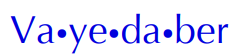
Taking a look at the first word of the chapter gives us a feel for the transliteration style:
Let’s move on to the next word:
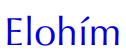
We can see that this scheme caters to the English speaker not only narrowly, in its choice of letters and letter-pairs, but also more broadly, in its choice to use capitalization and punctuation (period) in a manner analogous to their use in English.
Note that the use of an acute accent on the vowel of the stressed syllable, though having no analogy in English, may be familiar to English speakers if they have even briefly studied a Latin language that uses a similar system, such as Spanish.
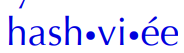
This stress-marking system becomes somewhat awkward for vowel sounds represented by doubled letters such as “ee”, as in verse 11:
(Their verse 11 is verse 10 in some editions. Their text, both in the location of its verse numbers and its sof pasuq marks, reflects a version of the taḥton cantillation not present in the Tiberian manuscripts. It is a version of the taḥton that, while centuries old, and thus “traditional,” is nonetheless part of the printed tradition rather than the manuscript tradition.)
Returning from that digression to the topic of stress-marking, note that with Elohím we have seen that they avoid the awkwardness that would be present in Elohéem. But they appear to use single-i and double-e (i and ee) interchangeably, i.e. inconsistently. A similar interchangeable inconsistency appears to exist with single-u and double-o (u and oo), but at least this is documented in their introduction.
Let’s skip the third word (et) and move on to the fourth:
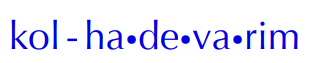
(This maqaf compound is the fourth chanted word; by another definition of “word” it includes both the fourth and fifth words.)
A minor point (but one I still find worth noting) is that Hebrew World’s maqaf is oddly low: it looks more like an English dash than a traditional (high) maqaf:
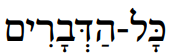
The fifth word gives us an example of non-final (and therefore explicit) stress:
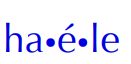
The first word of verse 2 is as follows:

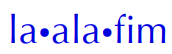
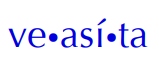
Here we see the tendency of this product to not separate alef or ayin syllables. I find this odd. It is one thing to give neither alef nor ayin any mark of its own; this is a margin on which many transliteration schemes differ. But treating syllables starting with alef or ayin as non-syllables seems to deny phonetic reality. This phenomenon (bug?) is not confined to initial alef and ayin. E.g. in verse 6:
and in verse 9:
(In the verse 6 example above, the first ‘a’ in the ‘ala’ of la·ala·fim is merely a ḥataf pataḥ, which could justify attaching it to the ‘la’ syllable rather than considering it to be a syllable of its own. But that would be inconsistent with the treatment of all other ḥataf vowels in this transliteration.)
The first (chanted) word of (Hebrew World’s) verse 3 has what was to me a surprising transcription of לֹֽא־יִהְיֶ֥ה:
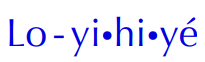
I was surprised to find not only the shewa to be vocal but also given an “i” rather than “e” vowel-value. But just because I was surprised doesn’t mean this is wrong. It may just represent a tradition that I am unaware of.
For now at least, we will conclude our review with what seems to be an interchangeably inconsistent use of apostrophe and “e” for vocal shewa in verse 7:
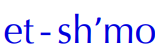
(Reasonably enough, this apostrophe seems to function not only as an ultra-short vowel but also as a syllable divider. I.e. et-sh’·mo could be considered a little awkward-looking.)
It is possible that what I have identified as inconsistencies are just consistencies whose rules I have not been able to “reverse engineer”. In that case, they are just failures in documentation. Or perhaps the inconsistencies do not follow rules, but are still intentional (not viewed as bugs). I assume this is the case with the documented interchangeability of u and oo. They are documented as representing the same sound, but no rule is given for why “u” might be used in one case and “oo” in another case.
Even if all interchangeabilities were documented, the wisdom of introducing multiple notations for the same sound might reasonably be questioned, as presumably the existence of multiple notations for the same sound in the source (pointed Hebrew) is one of the reasons for a phonetic transcription in the first place!
The inconsistencies that seem to characterize this transliteration are particularly surprising from a company that also offers automatic (and therefore presumably consistent?) transliteration software (part of its “Saffa” product).