| n | 37 |
| citation:book | 1Sam |
| citation:c | 17 |
| citation:v | 23 |
| citation:position | 12 |
| author:name | Ben Denckla |
| author:mail | bdenckla@alum.mit.edu |
| author:confirmed | true |
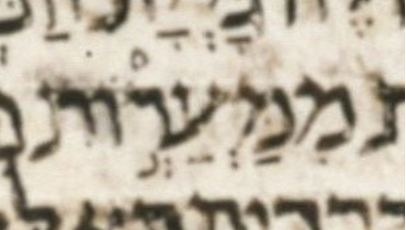
| description | Note that while creating the pointed qere, the transcriber changed a ḥataf pataḥ to a pataḥ under ayin |
| lc:folio | Folio_159B |
| lc:column | 2 |
| lc:line | 11 |
| lc:credit | Credit: Sefaria.org. |
| reftext | מִמַּעַרְכ֣וֹת |
| refuni | mem hiriq mem dagesh patah ayin patah resh sheva kaf munah vav holam tav |
| changetext | מִמַּעַרְכ֣וֹת |
| changeuni | mem hiriq mem dagesh patah ayin patah resh sheva kaf munah vav holam tav |
| notes:note | The manuscript’s pointed ketiv (MPK) is מִמַּעֲרְ֣וֹת. |
| notes:note-2 | The MPK’s ע has a ḥataf pataḥ where the qere has a pataḥ. |
| notes:note-3 | Unexpected ḥataf vowels are a known feature (bug?) of ל. I.e. this is rare but hardly unique. This unexpected ḥataf may well be unrelated to the ketiv/qere differences in this word. If it is unrelated, this should have been a bracket-1 or bracket-U note in WLC, not a bracket-a note. |
| notes:note-4 | Breuer notes that א and ק have the expected pataḥ under ע. (א is the Aleppo Codex and ק is the Cairo Codex of The Prophets.) |
| notes:note-5 | Dotan notes that strictly speaking, the implied qere is מִמַּעֲרְכ֣וֹת (ḥataf pataḥ under ע). |
| transnotes:transnote:action | Add |
| transnotes:transnote:type | a |
| transnotes:transnote:beforetext | מִמַּעַ |
| status | Pending |
| type | NoTextChange |