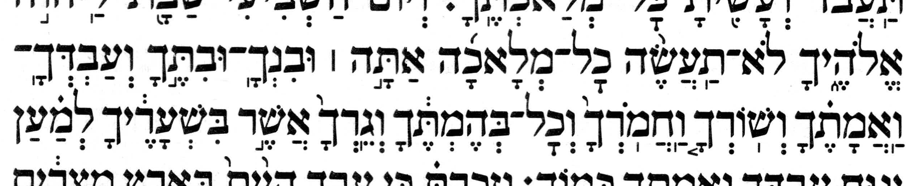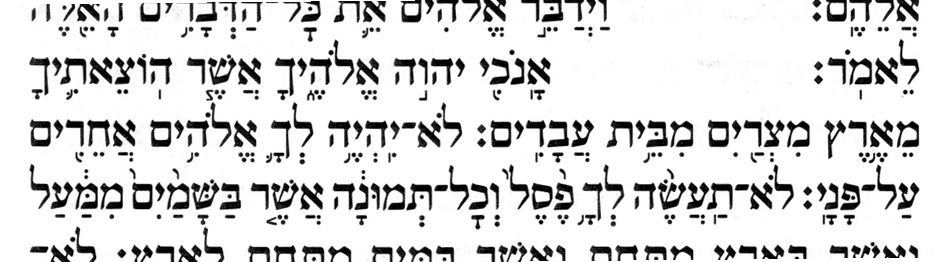
As the companion page explains, each Decalogue has four strands of cantillation: the printed tradition (p-trad) and the manuscript tradition (m-trad) each have their own טעם תחתון and their own טעם עליון. The most striking difference between the four strands is how they divide up the span אנכי…מצותי into chanted verses. (This span is typically identified as comprising the first two Commandments.)
That page lays out those four strands and grammar-checks the p-trad; this page serves only to document the claim that Koren follows the p-trad. Along the way it transcribes one of Koren's own notes.
Koren follows the p-trad for the Decalogues. In its Exodus Decalogue, Koren's main Decalogue (p. 113) is the p-trad תחתון and its appendix Decalogue (p. A38) is the p-trad עליון. Since no digital Koren exists, I established this by visually spot-checking Koren against Hebrew Wikisource's p-trad. The two scans below show enough of Koren's Exodus Decalogues to "diagnose" them both as p-trad.
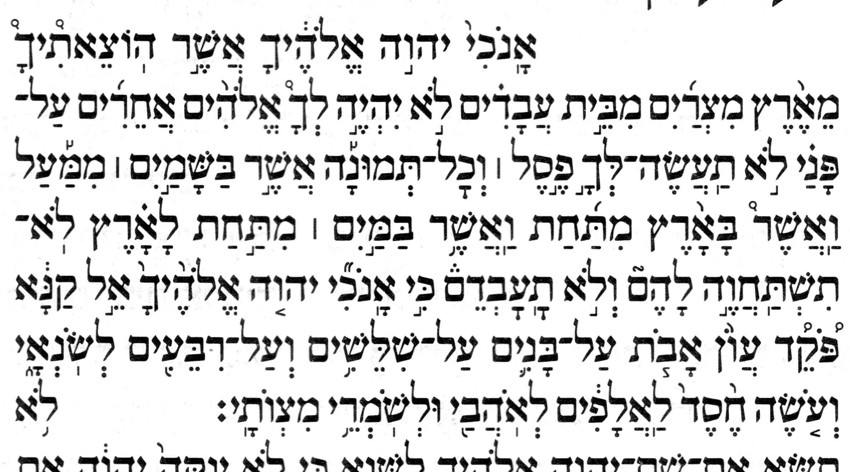
A note on the appendix Decalogue, keyed to the opening commandment אנכי…עבדים and citing רוו״ה.

לדעת רוו״ה, יש לקרוא את הדיבר הראשון עד "מבית עבדים"
בטעם התחתון.
In the opinion of רוו״ה {R. Wolf Heidenheim}, one should read the First Commandment (up to “מבית עבדים”) in the תחתון.
Notation: text in {curly braces} is my editorial addition. That includes the expansion of the abbreviation רוו״ה, which I tentatively read as ר' וולף היידנהיים (R. Wolf Heidenheim) — the grammarian whose editions fixed much of the printed dual-cantillation norm, so the likeliest referent here, though I have not confirmed the expansion. The parentheses are likewise an editorial addition; the note itself has none.
The note is the mirror of Simanim's p. 83 side-margin note. Koren's appendix prints the עליון by default — the merged, nine-verse p-trad structure, in which אנכי…עבדים ends on a revia rather than closing its own verse. The note flags the alternative, on רוו״ה's authority: read the First Commandment (through מבית עבדים) in the תחתון — i.e. as its own chanted verse (silluq + sof pasuq at עבדים), which keeps ten distinct commandments. That תחתון cantillation is one of the four strands on the companion page (the p-trad תחתון, identical on its boundary words to the m-trad עליון — through עבדים; at the span's other signal word, על־פני, the two part). So Koren, like Simanim, prints the p-trad structure as the norm and files the standalone-verse alternative under what one authority merely recommends — aware of the alternative, but not adopting it.
Koren follows the p-trad for the Decalogues, not the m-trad. The two traditions' most consequential divergence is over the opening span אנכי…מצותי — a divergence of chanted verse boundaries, which can be read off the accents on the span's two signal words, עבדים and על־פני. Koren lands on the p-trad side of that divergence on both strands: the p-trad תחתון in its Exodus main Decalogue (p. 113), and the p-trad עליון in its appendix Decalogue (p. A38).
One scope note: the finding above rests on the אנכי…מצותי span — the most striking p-trad/m-trad divergence. Koren makes the same p-trad choice at that span in both of its Decalogues: the Exodus one and the Deuteronomy (Vaetḥanan) one, whose תחתון main Decalogue starts on p. 280 and runs onto p. 281. There too אנכי…עבדים is its own chanted verse, closing on עבדים with a silluq + sof pasuq.
Koren's Deuteronomy also reaches a divergence its Exodus Decalogue cannot: the Shabbat commandment, where the p-trad and m-trad part again. There too Koren shows the p-trad — so its p-trad allegiance is unqualified, where the Simanim page finds Simanim's Tiqqun following the m-trad accents at that very commandment (an accents-only departure — Simanim's Tiqqun still follows the p-trad's chanted verse boundaries). So Koren happens to be pure p-trad at both divergence points, where Simanim's Tiqqun is not — and it is exactly that kind of impurity the Shabbat commandment's own signal words exist to catch, since an accents-only departure moves no chanted verse boundary and so leaves עבדים and על־פני reading p-trad throughout. The scan below is that commandment, with three signal words highlighted — not the only words the two traditions accent differently, but three disjunctively accented words that make a handy shorthand for telling the p-trad from the m-trad. In Koren's p-trad they have, respectively, a geresh, a revia, and a zaqef qatan; the companion page's appendix has the full details. One boundary on all this: what I have checked in Deuteronomy is the תחתון; I have not chased Koren's Deuteronomy עליון through its appendix, so the Deuteronomy half of the claim rests on the תחתון alone.