← Back to the case register.
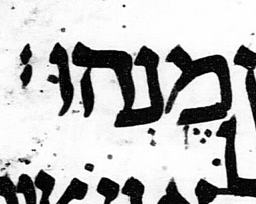
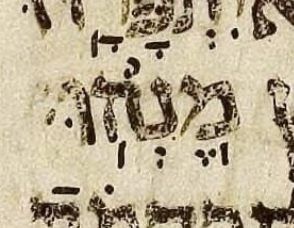
We usually regard an “early meteg”—a meteg to the right of its vowel—as meaningless. Should we also treat “early silluq” as meaningless? In both Aleppo and Leningrad, the stroke under the mem is to the right of its segol. This seems an extraordinary coincidence. (In Cambridge and Sassoon, the stroke under the mem is in its normal position: to the left of its segol.)
Aleppo has both strokes at Job 4:12.
Leningrad has both strokes at Job 4:12.
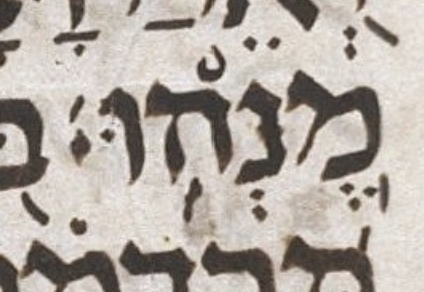
Cambridge has both strokes at Job 4:12.
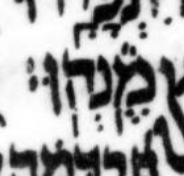
Sassoon has both strokes at Job 4:12. Sassoon's later stroke is far from vertical: it slants northeast to southwest. I have no idea whether that slant is meaningful, but it is too conspicuous to leave unmentioned.
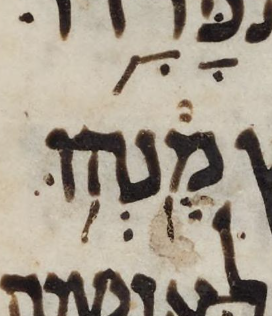
St. Petersburg Evr. II B 55, identified in MAM by the siglum ל-א, is a manuscript of the Prophets and Writings close to the Aleppo Codex. The National Library of Israel presents it together with its direct continuation, Evr. II B 247, but this crop belongs to Evr. II B 55. At Job 4:12 it has the silluq alone in this word—the only manuscript represented on this page that has that form.