Alternatively, you can click on an individual Hebrew word to toggle only that word's spacing.
← Back to Meteg after the stress.
With very few exceptions, manuscripts and printed editions use the same vertical stroke (φ1) for both meteg and silluq (φ2). Here we coin a portmanteau “metsil” to describe that ambiguous stroke (φ3). A verse-final word always has at least one metsil. If it has only one metsil, that metsil must be the silluq. But if it has more than one metsil, it is not clear which one is the silluq. Fortunately, in all but a handful of cases, the last metsil is the silluq. This document discusses the handful of cases in which the last metsil is a meteg rather than the silluq. That is to say, in these cases there is a meteg after the silluq.
For example, Jacobson, in his CHB (p. 31), brought a case at 1 Sam. 17:5 to our attention. In the Leningrad Codex, and in the many editions that, for better or for worse, try to stick close to that manuscript, the final word (letters נחשת) has a meteg after the silluq:
נְחֹֽשֶֽׁת׃
Or, coloring its stressed syllable green and the syllable of its later meteg yellow (for “caution”):
נְחֹֽשֶֽׁת׃
In contrast, in other manuscripts and editions, there is no such meteg after the silluq:
נְחֹֽשֶׁת׃
These other manuscripts and editions include the following:
We might compactly represent the situation like this:
-L-----
A-5ECKS
That notation uses one-character manuscript/edition codes to show, on its first line, who has a meteg after silluq, and on the second line, who doesn't. The codes are as follows:
| code | manuscript or edition | range |
|---|---|---|
A |
Aleppo Codex | |
L |
Leningrad Codex | |
5 |
Sassoon 1053 | |
E |
EVR-II-B-55 | |
C |
Cairo CoTP | Prophets |
7 |
Cambridge 1753 | Writings |
K |
Koren Classic Tanakh | |
S |
Simanim Tanakh |
So, for cases in The Prophets, the full possible array of codes is AL5ECKS, and for cases in The Writings, the full possible array is AL5E7KS. Note that in the array for The Writings, there is a '7' where for The Prophets we had a 'C'.
Having introduced our notations through the 1 Sam. 17:5 example above, we now present all our cases of concern. In the table below, the "bcv & img" column contains links to pages showing crops of the relevant manuscript images.
| bcv & img | Sources | |
|---|---|---|
| נְחֹֽשֶֽׁת׃ | 1 Sam. 17:5 | -L----- |
| לְכֻלָּֽהְנָֽה׃ | 1 Kgs. 7:37 | A------ |
| גַּם־עָֽתָּֽה׃ | 1 Kgs. 14:14 | -L----- |
| הִתְרֹעָֽעִֽי׃ | Ps. 60:10 | -L----- |
| חֽוּשָֽׁה׃ | Ps. 70:2 | -L----- |
| יְבָרֲכֶֽנְהֽוּ׃ | Ps. 72:15 | -L----- |
| מֶֽנְהֽוּ׃ | Job 4:12 | AL5-7-S |
In the entry for 1 Kgs. 7:37:
A------
-L5-CKS
A dash in both lines at the “E” position means that no classification is recorded for EVR-II-B-55 because no image of EVR-II-B-55 contains 1 Kgs. 7:37: its surviving text breaks off at 2 Sam. 1:16 and resumes at 1 Kgs. 8:61.
As mentioned above, we became aware of 1 Sam. 17:5 from Jacobson, CHB, p. 31. We became aware of 1 Kgs. 7:37 from Breuer, CoS, ch. 8 §47, footnote 54 (p. 355 in the Wengrov English translation). We became aware of the remaining five entries from searches of our own.
When we later compared all seven cases with the reference works catalogued below, we found a mixed picture: some works merely have the relevant form or note it for another reason, rather than identifying the meteg after silluq as an anomaly. Dotan does so only for 1 Sam. 17:5, by placing it in BHL Appendix A. None of the sources we found calls out Job 4:12 as an instance of this anomaly, so we regard our recognition of that case as a discovery of our own.
MAM's note at 1 Kgs. 7:37 reports that Aleppo has the later meteg, while Leningrad has the silluq alone. MAM's body text has the meteg after silluq, following Aleppo, as is MAM's usual policy (φ4).
At 1 Kgs. 14:14, UXLC acquired a meteg after the silluq through Daniel Holman's change proposal 2022.08.31-17.
Below we catalog how these seven cases are or are not recorded in works by Breuer and Dotan.
| bcv | Breuer | Dotan |
|---|---|---|
| 1 Sam. 17:5 | DM | BHL AppA |
| 1 Kgs. 7:37 | CoS | ✗ |
| 1 Kgs. 14:14 | DM | ✗ |
| Ps. 60:10 | DM | BHL body |
| Ps. 70:2 | DM | BHL body |
| Ps. 72:15 | DM | BHL body |
| Job 4:12 | ✗ | BHL body |
The abbreviations and codes in the Breuer and Dotan catalogue are decoded below:
| scholar | code | decoding |
|---|---|---|
| Breuer | DM | Da'at Miqra |
| Breuer | CoS | The Cantillation of Scripture |
| Dotan | BHL | Biblia Hebraica Leningradensia |
| Dotan | ... AppA | ... Appendix A |
| Dotan | ... body | ... body, i.e. non-Appendix text |
Further notes on the Breuer and Dotan catalogue:
In this document, we ignore the vexing set of angles, some quite far from the vertical, that both meteg and silluq can take on, both within a single manuscript and across manuscripts.
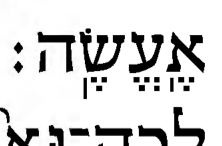
One book whose typography distinguishes silluq from meteg is the 2005 revised edition of The Torah: A Modern Commentary (W. Gunther Plaut, original editor; David E. S. Stein, revised-edition editor). There are thousands of examples that could be used, but let's use its version of the last word of Num. 23:26 (letters אעשה), because in this word both the silluq and the meteg appear next to a segol, providing an obvious visual yardstick:
In this document, we set aside the broader set of accents that a similar stroke can represent: merkha, yored, mayela, tipeḥa, tarḥa, and deḥi. In prose verses, Yeivin, ITM §210, describes a secondary accent with the form of tipeḥa in the word that has silluq; §216 calls the corresponding accent mayela. Breuer, CoS, ch. 11 §80, records secondary tarḥa or merkha in the word that has silluq in poetic verses. The additional accents in those examples precede silluq, so they are outside this document's post-silluq scope.
The MAM dataset diverges from Aleppo only when a specific editorial policy requires a different form or, in a rare case, when Aleppo is fairly clearly erroneous or fairly clearly outside the manuscript tradition of which Aleppo is generally the greatest example. Because meteg after silluq is so rare, such a judgment is difficult here, so it makes sense that the MAM dataset follows Aleppo in the two of our seven cases in which Aleppo has meteg after silluq: 1 Kgs. 7:37 and Job 4:12.
Though the MAM dataset preserves (and notes) these two cases of meteg after silluq, these two meteg marks may not be appropriate for all editions. In particular, they are not likely to be appropriate for an edition that has no way to note the pitfall. So, for example, MAM-for-Sefaria omits both meteg marks.