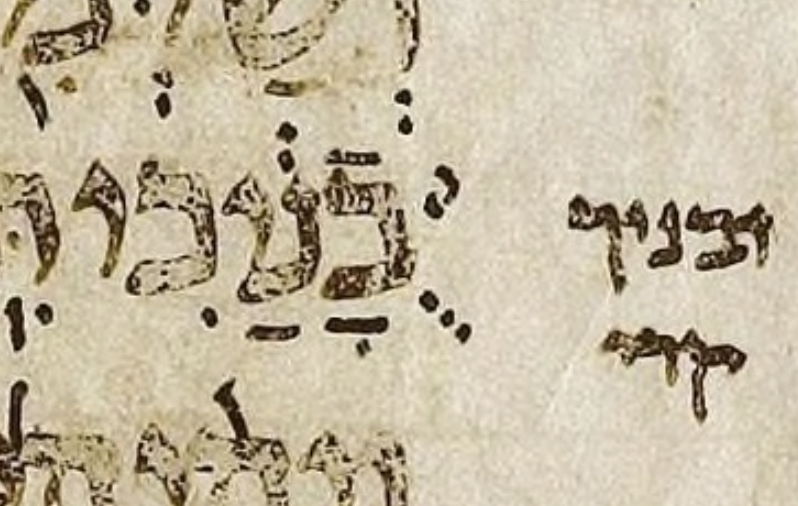
In Job 38:12, the Jerusalem Crown edition puts a פתח on no letter. The פתח floats before the ש of שחר. Although neither μA nor μL presents this כתיב/קרי like this, there is manuscript precedent for such a floating presentation. This page presents some examples of that precedent.
In 2 Kings 4:7 (U, M), there is a קרי of וּבָנַ֔יִךְ corresponding to a כתיב of בניכי.
This is hard to show in the “pointed כתיב” style of קרי/כתיב presentation favored by the manuscripts. In such a style, a קובוץ floats before the ב of בניכי. The קובוץ is an orphan: it belongs to no letter of the כתיב word.
Actually, it belongs to no letter of the קרי word either! But it is understood to represent a שורוק. Or, another way of looking at this קובוץ is that it is understood to represent just a שורוק dot, not the entire שורוק.
The first image below is from μA; the second is from μL. The קובוץ is faint in μL, almost invisible. (They are under the ת of the previous word.)
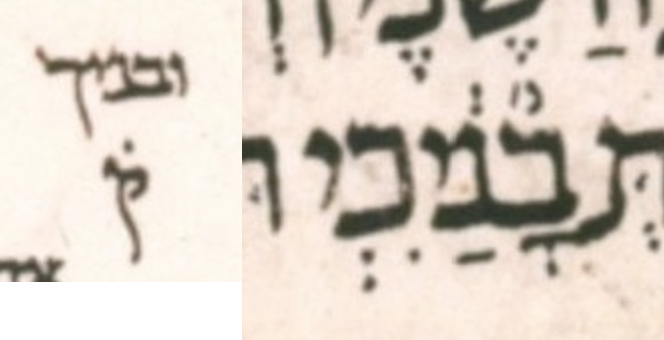
My assumption is that a שורוק dot was not allowed to be an orphan for one or more of the following reasons: (1) it is placed too high, i.e. not a below-mark, (2) it is too small, and (3) it has too many other meanings (דגש and מפיק).
It is more common for a כתיב to lack a final שורוק than for it to lack initial שורוק. When a כתיב lacks a final שורוק, we see a related use of קובוץ. An example is found in 1 Samuel 12:10 (U, M) where, in Tiberian manuscripts, a pointed כתיב of וַיֹּאמְרֻ֣ is paired with an unpointed קרי of ויאמרו. In many printed editions, this would be shown as an unpointed כתיב of ויאמר paired with a pointed קרי of וַיֹּאמְר֣וּ.
Note that the קובוץ of וַיֹּאמְרֻ֣ is not really an orphan, since it belongs to the last letter of the word (ר). Nevertheless, I consider the notations to be related, if not strictly analogous. See this list of WLC a-notes for more examples of final קובוץ. Also, that list shows many examples where דגש is not allowed to be an orphan, supporting my claims as to why שורוק dot, too, is not allowed to be an orphan.
In Lamentations 4:16 (U, M), there is a קרי of וּזְקֵנִ֖ים corresponding to a כתיב of זקנים.
As in 2 Kings 4:7, the קובוץ floats before the first letter of the word, which in this case is ז. Here is the way this word looks in Sassoon 1053:
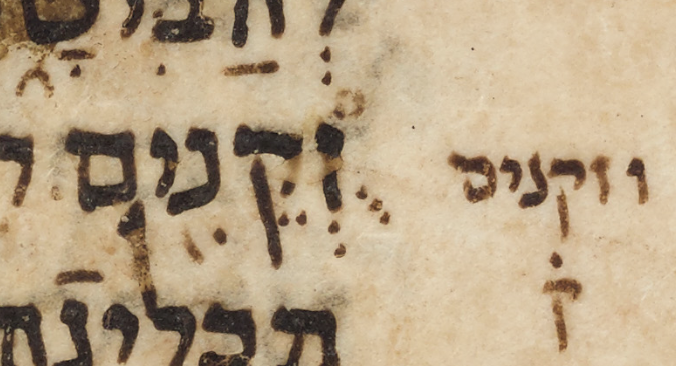
(We provide an image from Sassoon 1053 rather than from μA and/or μL because μA is lost here and μL does not use this (or any other) notation representing the שורוק dot in the קרי.)
2 Samuel 18:20 (U, M) is a קרי ולא כתיב: the word כֵּ֥ן is read but not written, where by “not written” we mean not written in formal texts. Such formal texts include the main columns of a Tiberian manuscript and the text of an unpointed scroll.
So, in the main columns of a Tiberian manuscript, there are no letters כן on which to put the קרי pointing. This represents a more extreme case of orphan קרי points than the previous two examples, since there is no word to which the orphan points can “snuggle up” to. In other words, the vowel and accent marks of the קרי word, כן, float in the space between the surrounding כתיב words. Or rather, the marks would float in that space if enough space had been left for them. As it is, they reside somewhat awkwardly and confusingly beneath the ל.
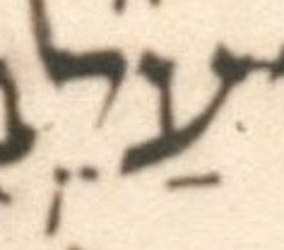
Several other examples of complete orphans like this can be found in the same list of WLC a-notes mentioned above.