Psalms 17:14 — the double tsinnor
Psalms 17:14 carries a feature unique in the Three Books: two צנור (tsinnor) marks in a row. This page records what is known about that doubled mark — its uniqueness, the manuscript evidence, the MAM documentation notes, and Breuer's analysis — and explains how the accent-grammar checker treats it. The material formerly appeared in the Psalms 17:14 section of the poetic ungrammatical-verse report; once the checker began accepting the verse (see below) that section disappeared, so the discussion is preserved here.
The doubled mark and its uniqueness
A scan of the disjunctive accent stream of every poetic verse finds that these
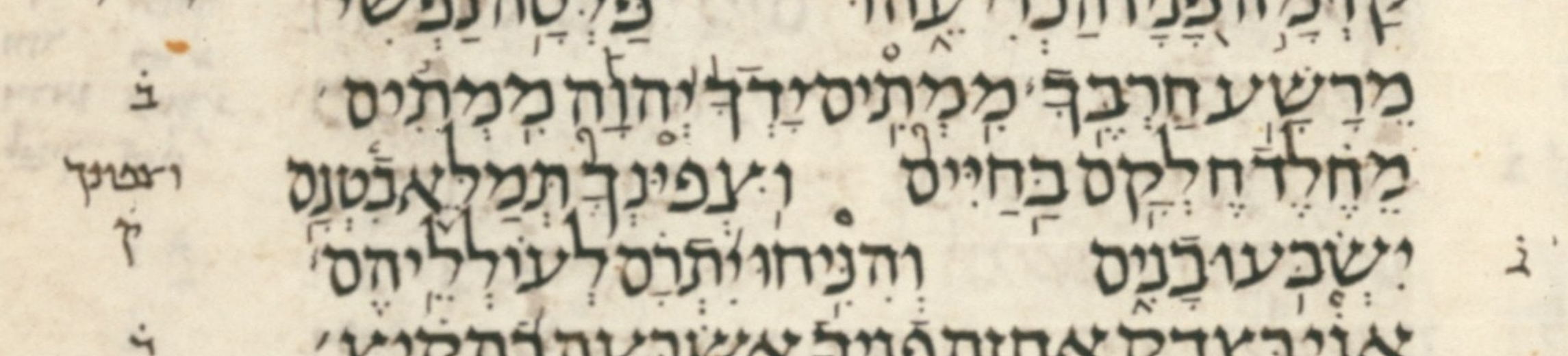
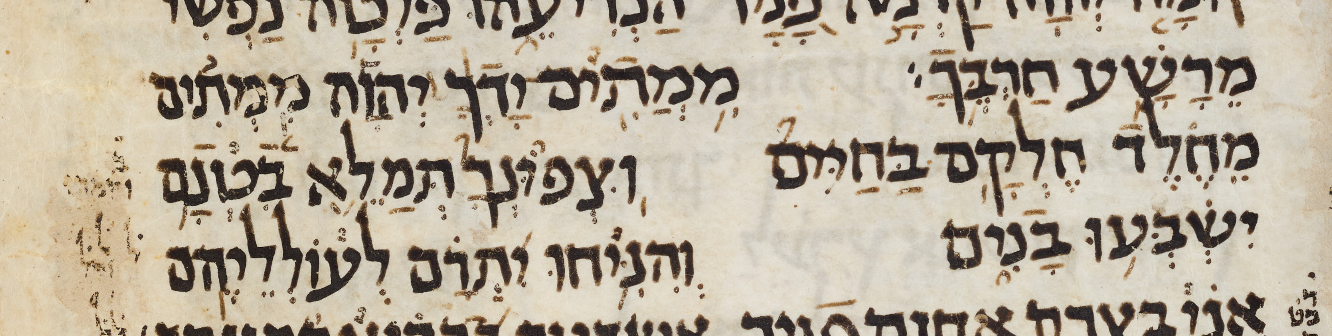
two adjacent tsinnor marks are unique in the Three Books: of the 250 poetic verses
carrying at least one tsinnor, Psalms 17:14 is the only one in which two tsinnor
occur consecutively. Both arise from genuine Michigan-Claremont 02
(tsinnor) codes — not a swallowed 82 (tsinnorit) — on adjacent words:
בַּחַיִּים and the qere וּצְפוּנְךָ.
Manuscript evidence
This verse is not extant in the Aleppo Codex.
Though in the Leningrad Codex (L) the first of the two tsinnor marks is a little oddly shaped, S1 (Sassoon 1053) clearly shares these two adjacent tsinnor marks, with no questions of penmanship.
How the checker treats it
The checker's underlying grammar still cannot parse this sequence directly, and
never could: a repeated tsinnor standing before an oleh-weyored that itself carries
a servus is beyond its LALR(1) power (the servus is ambiguous between the second
tsinnor and the oleh). That limitation has not changed. What changed is that the
verse used to be reported as NO_PARSE and no longer is.
The checker now accepts the verse, on a principled basis: a repeated disjunctive is the same divider written twice — Yeivin notes that the zarqa (the prose counterpart of the tsinnor) may be repeated, and Breuer says the same of the doubled tsinnor — so for grammaticality a repeated divider counts once. Rather than extend the grammar, the checker adds a step ahead of it: before parsing, it collapses the run of two tsinnor marks to one, and the grammar then parses what remains. The verse's recorded accents — both tsinnor marks — are left untouched, so the WLC-vs-MAM comparison still sees the doubled mark.
MAM's documentation notes
This verse is heavily commented upon by MAM (see the translation of those notes), but the comments either do not concern cantillation, or concern cantillation only in ways that would not change the accent-grammar issue. The four notes turn on a secondary merkha plus ga’ya, a חטף [ḥataf], a missing shva, and the placement of the silluq — none of which alters the disjunctive skeleton, and the conjunctive servus chain the grammar parses is permissive enough that a secondary conjunctive is absorbed harmlessly.
Breuer's analysis
Breuer treats the doubled tsinnor in two places. In The Cantillation of Scripture, Ch. 11 (footnote 11, attached to the Psalms 17:14 example חֶלְקָם בַּחַיִּים), he calls this “the sole example of two consecutive [tsinnor] marks” in Scripture. Following Wickes (p. 81 n. 4), he holds that the servant's exceptional cantillation results from the exceptional (doubled) mafsik, and he notes a parallel in the Twenty-One Books (Ch. 3 §16 III): there too the servant of the zarqa changes where there are two consecutive zarqa marks.
His structural account is in Ch. 10 §9, on the subdividers of the oleh-weyored domain. (Breuer's English translation calls such a subdivider a “viceroy”; its default form is the big revia’ / revia gadol.) Psalms 17:14 is one of very few verses with three such subdividers in the oleh-weyored realm, and its cantillation, he says, is exceptional:
“In example II [Psalms 17:14], the final viceroy is [tsinnor], because it is not next to the oleh [weyored]. The penultimate viceroy is [tsinnor] preceded by a big revia’; but we would expect both these viceroys to be big revia’ marks.”
That is: where the rule would place a pair of big revia’ subdividers before the oleh-weyored, Psalms 17:14 substitutes a tsinnor for each — and that substitution, applied to two adjacent subdividers at once, is precisely what yields the unique run of two consecutive tsinnor marks. It is the same divider (the tsinnor) appearing twice, which is exactly why the accent-grammar checker can accept the sequence by counting the repeated divider once (above).
Source: M. Breuer, The Cantillation of Scripture, Ch. 10 §9 and Ch. 11 n. 11 (with Wickes p. 81 n. 4). The Hebrew of the scanned examples is not reproduced here, as the OCR of the pointed text is unreliable.