This is the second article in a series. The series is about errors in BHS and/or WLC. The other articles in the series are as follows:
In this article I’ll explore two errors in WLC that are similar to each other. As in the first article, we will look at editions that share these errors and editions that lack these errors. Editions that share these errors likely share them causally, by being derived from WLC, rather than coincidentally. Editions may lack these errors because they never had them, or because they have been corrected.
As in the first article, my intent is both specific and general. Specifically, I’m trying to draw attention to the shortcomings of close-to-WLC editions. They are not appropriate for the general purposes for which they are widely pressed into service. (Indeed, these editions are not even the best for the narrow purpose WLC was intended to serve: being a strictly diplomatic edition of ל.)
Generally, I’m trying to shed light on how one makes and improves high quality editions of the Hebrew Bible. The specifics of the first article gave the reader a taste of general issues such as the grammar of accents and the use of multiple manuscripts. Here, the specifics will again give the reader a taste of more general issues. In this case, our use of specific masorah notes gives a taste of what those notes are like, in general.
Now, back to the specifics. WLC fails to identify two cases in which the word אם is a ketiv velo qere (henceforth kq: kq with the q struck through). As a reminder, a kq is a word that finds itself in the following sticky situation:
According to the writing (ketiv) tradition, this word … |
should be written (e.g. in unpointed scrolls) |
According to the reading (qere) tradition, this word … |
should not be “cried out” (chanted or spoken aloud) |
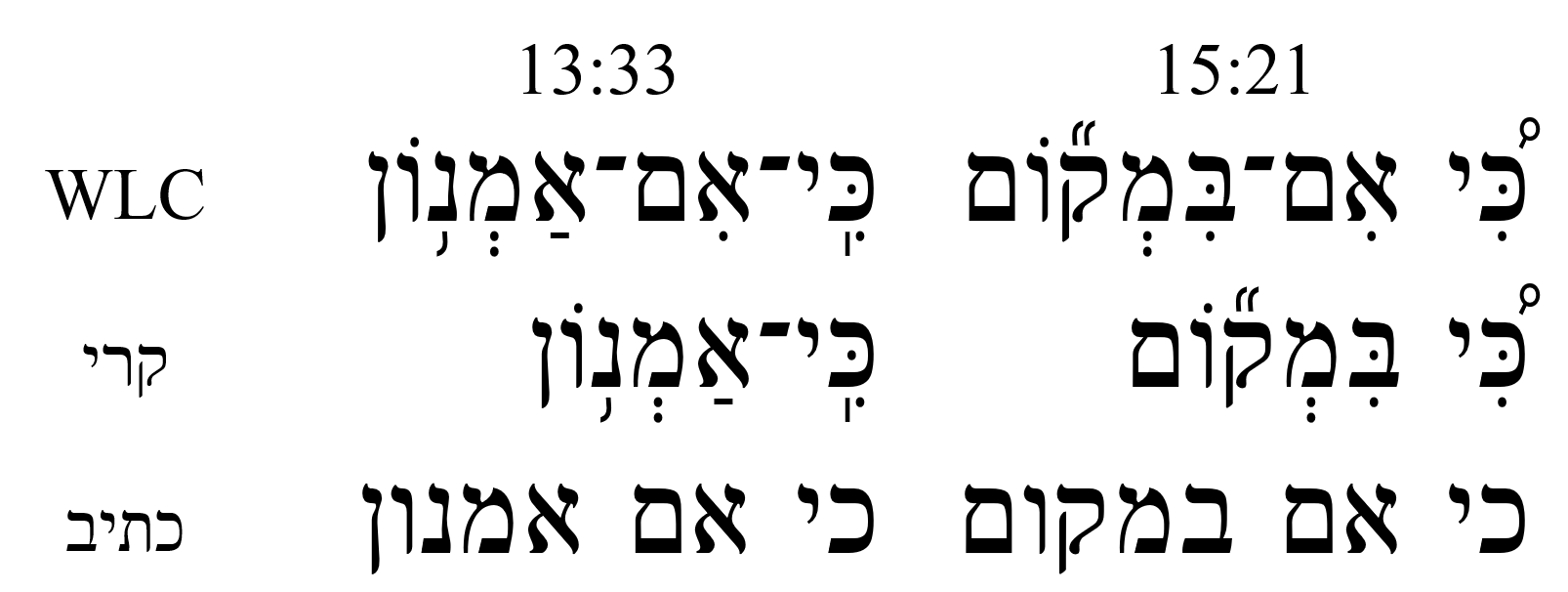
In these two cases, WLC correctly transcribes the body text of BHS, which in turn correctly transcribes ל. But WLC fails to identify the letters (and pointing!) of אם as belonging only to the writing (ketiv) tradition. These cases are both in 2 Samuel: 13:33 and 15:21. Below we show them in three ways:
Above, we separate out the qere and ketiv into their own rows rather than trying to show them “inline” since:
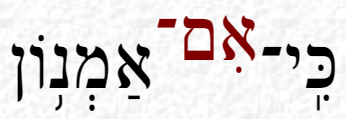
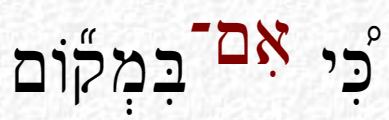
In UXLC, which for these purposes can be considered a corrected version of WLC, the two cases look like this (as rendered in UXLC’s canonical edition at tanach.us):
|
|
The correction involves no change to any letter or pointing. The correction simply identifies אִם־ as belonging only to the writing (ketiv) tradition. In the underlying UXLC dataset, this means wrapping אִם־ in a <k> rather than <w> XML tag. (The <k> tag is for ketiv words and the <w> tag is for normal words.) In the canonical edition of UXLC, ketiv words are shown in a reddish-brown color and above the normal text’s baseline.
To reiterate: WLC provides a good representation of how these words appear in BHS and ל. In each case, the only way in which WLC differs from BHS and ל is by lacking a masorah circle. This lack of a masorah circle is expected. What is unexpected is that WLC fails to reflect the meaning of the masorah note “called out” by the circle. That masorah note identifies אם as a kq. (Actually, in 15:21, BHS has a masorah circle not only above אם but also right before & right after it. These circles before and after are not relevant here, but for completeness we discuss them much further below.)
It is not surprising that these errors in WLC are shared by Logos LHB and Accordance HMT-W4. These errors were also shared by UXLC, but I proposed corrections and they were accepted (13:33, 15:21).
WLC’s errors here are not errors in BHS. They are merely two of those rare cases in which WLC did not faithfully transcribe BHS. WLC’s failures are understandable here because of the following:
The factors above give me some sympathy for the difficulty in transcribing BHS in these two cases. On the other hand, it is disappointing that the transcribers failed to take advantage of the classic Masoretic error-detection mechanism: lists and counts. This mechanism is included in BHS in all 8 kq, so they should have noticed it in at least one of the 6 kq that they did transcribe correctly.
Here’s the מ״ק-BHS for the 2Sam 15:21 case of kq, showing the count of 8 kq:

All 8 מ״ק-BHS take this form, varying only by the ketiv word in question and the footnote number. I.e. all 8 מ״ק-BHS take the following form:
k חד מן חn כת̇ ולא קר̇
where:
Expanding its footnote and abbreviations, this note can be translated to mean:
k is one of the 8 kq listed in Mm. 2752.
I have been careful to call this note a מ״ק-BHS, not a מ״ק-ל, because this note is a helpful mix of a מ״ק-ל and a מ״ג-ל. Coloring the מ״ג-ל part green and square-bracketing it yields:
k [חד מן חn] כת̇ ולא קר̇
I.e. the actual מ״ק-ל merely reads (modulo differences in abbreviation):
k כת̇ ולא קר̇
For example, for k = אם:
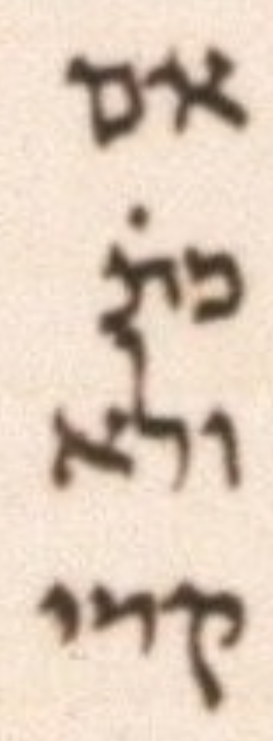
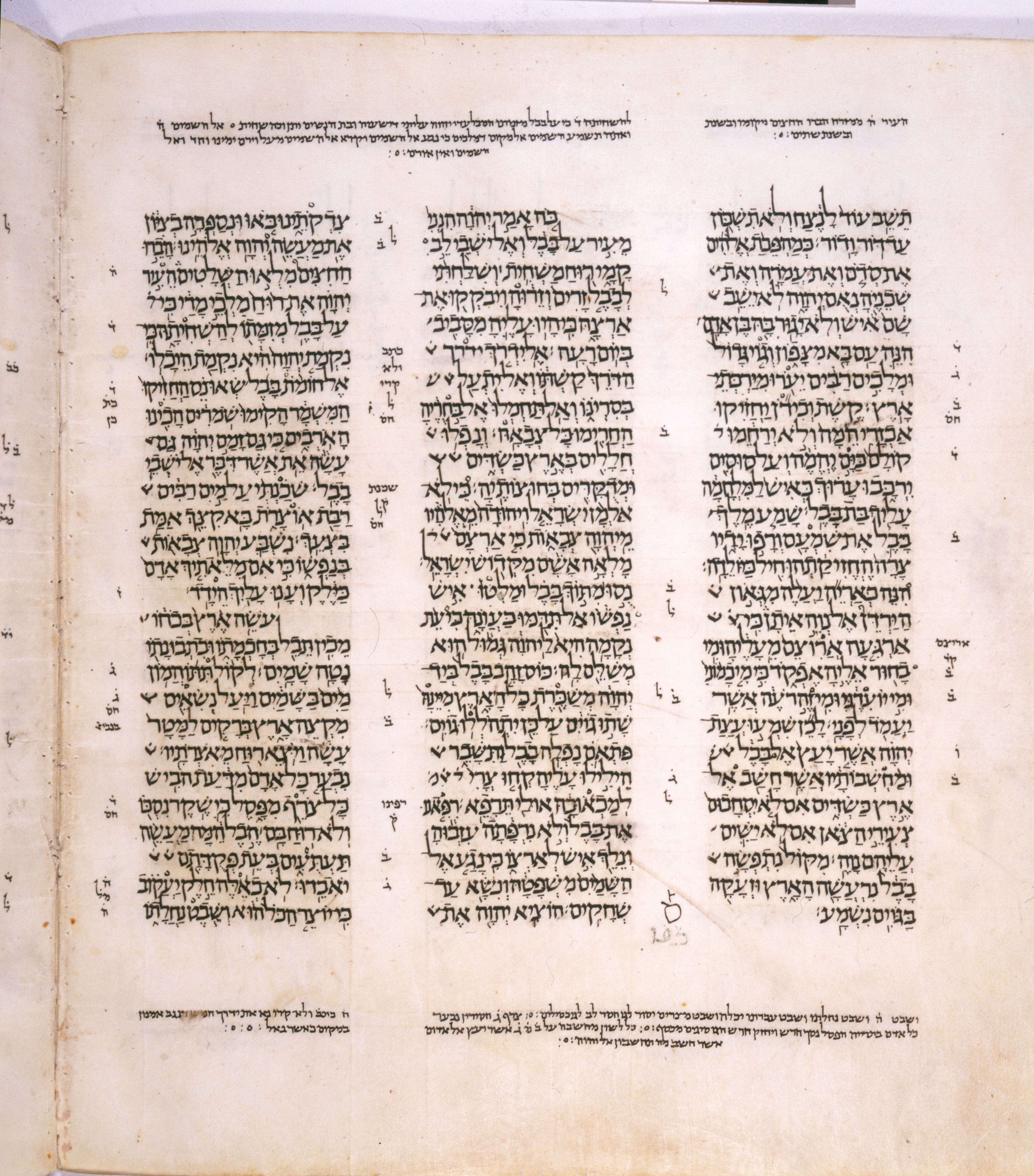
Presumably BHS’s Mm. 2752 is the מ״ג-ל on page 274B (the page of the Jer. 51:3 ידרך kq). In this note, the count of 8 kq is given, and those 8 cases are identified in the cryptically concise form that is typical of masorah gedolah notes:

חׄ כותבׄ ולא קרי נא את ידרך חמש דנגב אמנון במקום כאשר גאל
As fun as they are, we will not delve into the details of this list except to say that the 8 cases are only identified with sufficient detail to check them against a fully-detailed list. They are not identified with sufficient detail to constitute a fully-detailed list. For more information see Dotan and Reich’s Masorah Thesaurus.
It is disappointing that the WLC transcribers failed to take advantage of the error-detection mechanism provided by ל, especially since this mechanism was helpfully reproduced in all 8 relevant locations by BHS. Such errors undo the work of the Masoretes despite the mechanism intended to avoid such undoing. In other words, the Masoretes (and the BHS editors!) were well aware of how easy it would be to miss these kq, so they added a mechanism to try to make sure they weren’t missed. This mechanism failed.
Commendably, the JPS HET corrects these errors in WLC:
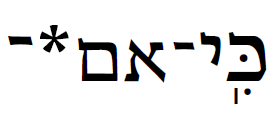

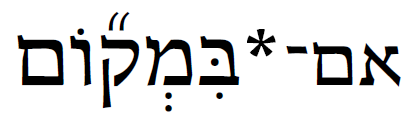

BHL and Keter Yerushalayim correctly identify these kq. This is not surprising since these editions were overseen by great scholars of the Masorah. Koren implicitly identifies these kq by leaving them unpointed, but to me this is dangerously subtle. I give Koren “half credit” 😉.
MAM correctly identifies these kq. The “MAM with doc” edition also includes a list called “x-velo-y-k-velo-q”, which is a version of the Masoretic list of the 8 kq. This list is one of many “features of interest” lists that are part of “MAM with doc.” Some of these lists mirror lists or counts made by the Masoretes. The rest of these lists, though not Masoretic in that strict sense, are certainly Masoretic in spirit.
These lists are generated by a program that runs on MAM’s sources. Thus they cannot get out of sync with MAM’s sources. In this way we avoid the problem the Masoretes had, where sometimes a masorah note would contradict the body text of the manuscript in whose margin it was written.
Did ל get these cases wrong or right?
My answer is the typical hedge: “yes and no.” The fact that אם is pointed in ל (i.e. the fact that אם has ḥiriq and maqaf marks) contradicts the masorah qetanah of ל. The pointing is wrong but the מ״ק is right. To be clear, the pointing is not wrong in the sense that, for example, the ḥiriq should be a tsere or something like that. The pointing is wrong in the sense that there should be no pointing at all there. The מ״ק is right not only according to other manuscripts (not discussed here) but also according to ל itself, in its masorah gedolah note elsewhere (on page 274B).
The naqdan of ל (the pointing scribe of ל) made an error by pointing these two words. These errors did not cause errors in BHS, but these errors are probably what caused WLC to fail to identify these words as kq.
This is one of the many pitfalls of BHS’s fateful decision to build a critical edition using ל as its base text rather than some eclectic consensus text. Though Dotan’s BHL is not a critical edition, it provides a useful contrast to BHS. BHL meticulously transcribes ל, in fact it transcribes ל better than BHS. But, importantly, BHL transcribes ל in its notes whenever ל’s errors or idiosyncrasies would be inappropriate for a general-purpose text. In contrast, by using ל as its body text, BHS contributed to the misunderstanding that ל somehow is the consensus Masoretic text.
Some of the fault for this misunderstanding does not lie with BHS, but rather lies with the inappropriately general ways in which BHS’s body text has been pressed into service. For example, it is one thing for the mention of errors in ל to be relegated to notes; but it is quite another for those notes to be stripped away, as in Accordance and Logos, where the BHS apparatus is only available as a separate product!
Did BHS get these cases wrong or right?
BHS commits no error by accurately transcribing an error in the body text of ל, because BHS is a strictly diplomatic edition of ל. But BHS can be faulted if it does not note the error. BHS has apparatus notes on both אם but only the note on 15:21 indicates an error in ל. Here are the notes (with some expansion of some abbreviations) (𝔊=Greek, 𝔏=Latin, 𝔖=Syriac, 𝔙=Vulgate):
13:33 אם: > nonnulli Mss cf 𝔊AMs𝔏115𝔖𝔙
15:21 אם: sic L; > pauci Mss cf 𝔊𝔖𝔙; permulti Mss ut Ketib
Ignoring “ > pauci Mss cf 𝔊𝔖𝔙 ” since non-Hebrew manuscripts are irrelevant for our purposes, the 15:21 note is reduced to “sic L; permulti Mss ut Ketib,” which I take to mean:
While we’re scrutinizing BHS, I will return to something I mentioned in passing far above: in BHS, the אם of 15:21 has not only a masorah circle right above it, but also has one right before and right after it:
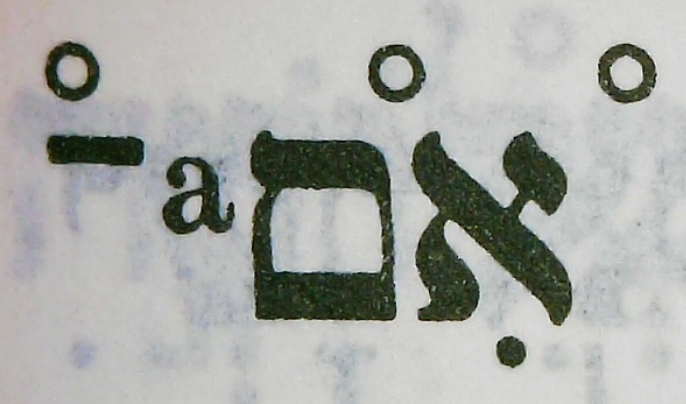
I am confused by this since there is an additional masorah circle earlier in the line, bringing the total to four, yet there are only three masorah notes in the margin:
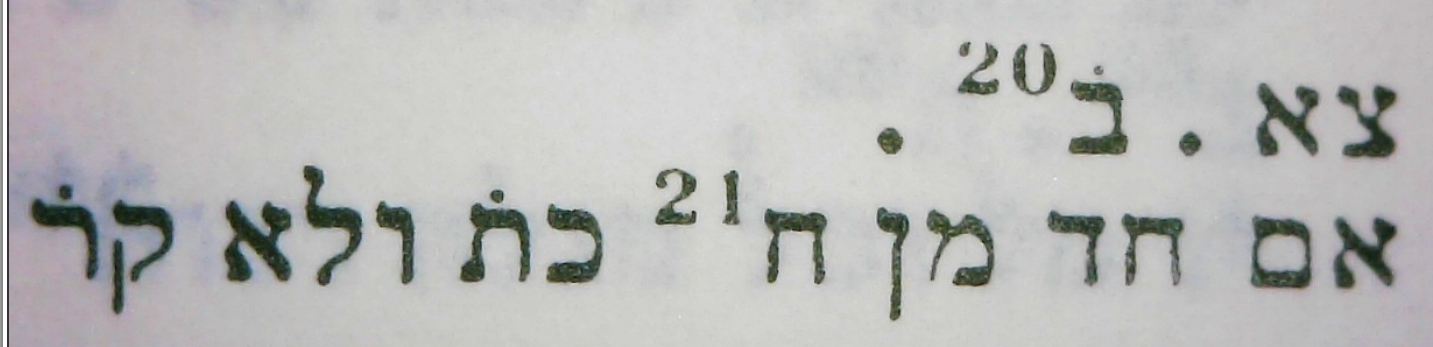
The masorah circle earlier in the line appears on ויאמר, like this:
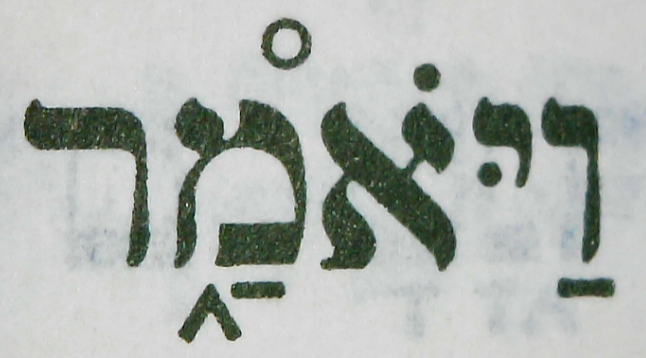
I take the first note, צא, to apply to ויאמר, i.e. to apply to the first masorah circle on the line. צא represents the number 91 despite its lack of “number dots” above tsade and alef. In similar contexts, the number dots do appear, e.g. in 3:33:

(By the way, this line above also has what seems to be an extra masorah circle.) There are actually 121 cases of this special pausal form of ויאמר, not 91. But only 4 of Job’s 34 are counted, with the remaining 30 only eluded to in the first of these צא notes (Gen 14:19). See Dotan and Reich’s Masorah Thesaurus.
I take the second note, ב̇20 (bet with an above-dot and a callout to note 20), to apply to the second masorah circle on the line, which is the circle right before אם (or, if you like, right after כי.). Note 20 says “Cf Jer 22,12 et Mp sub loco.” The first two words of Jeremiah 22:12 are indeed quite analogous to the qere of 2 Samuel 15:19:
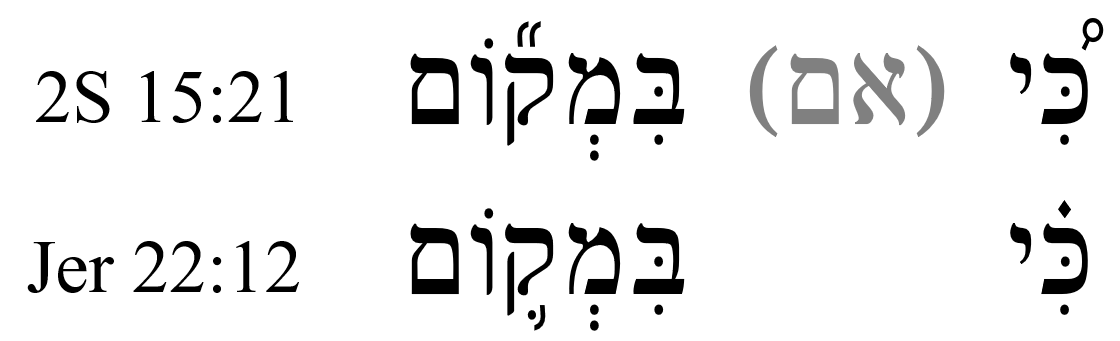
BHS’s “Mp sub loco” for Jer. 22:12 is complementary: it is ב̇12 (bet with an above-dot and a callout to note 12), where note 12 says “Cf 2 S 15,21 et Mp sub loco.” The masorah circle corresponding to this note is, as in 2S 15:21, right after כי (or, if you like, between כי and במקום).
I take the third note, אם חד מן ח20 כת̇ ולא קר̇, to apply to the third masorah circle on the line, which is the circle above אם. We have discussed this note above. It is one of 8 notes like it.
There seems to be no note corresponding to the fourth masorah circle on the line, which is the circle just after אם (or if you like, above the maqaf).
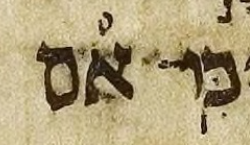
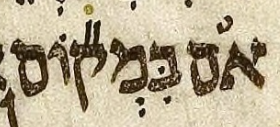
In the Aleppo Codex, our two cases appear unpointed, as one would expect: no hiriq under the alef of אם and no maqaf after the final mem of אם. The only “decoration” on אם is the masorah circle.
In the Hebrew Wikisource edition of MAM, our two cases are rendered like this:
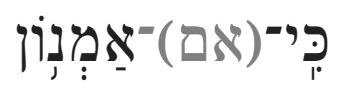
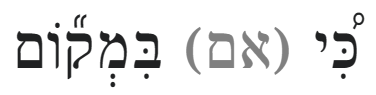
This edition of MAM renders kq in gray and in parenthesis. But in 13:33, the spurious maqaf of the naqdan of ל seems to have propagated here, albeit in gray, but outside of the parenthesis! Is this an error? We don’t think so. Rather, it is this edition’s way of showing, in an “inline” way, ketiv words inside maqaf compounds. The maqaf in question is placed outside the parenthesis, to show that it is not part of the ketiv proper. But it is still gray, to show that it is not really part of the qere either.
The idea behind this gray maqaf is to prevent the ketiv from visually breaking up the maqaf compound of the qere: כי־אמנון. One might imagine a variety of other ways to express this. For example, we might use a very long maqaf:
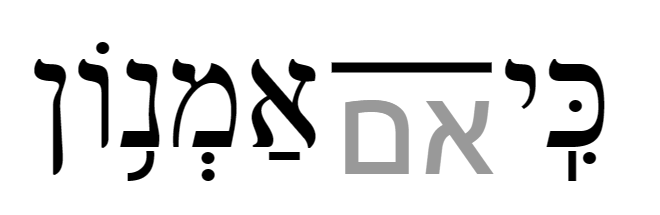
All such alternatives I can think of are typographically complex, beyond the scope of what Wikisource can easily express.
Let’s finish by summarizing. WLC missed the two instances of kq (ketiv velo qere) in 2 Samuel.
These errors represent a failure of the Masoretic mechanism put in place to try to avoid such errors.