The Israel Bible: this ain't no Koren edition
The Israel Bible (2018) comes from Menorah Books, which its copyright page calls an imprint of Koren Publishers Jerusalem. Its acknowledgments praise Koren as Israel's foremost Bible publisher and thank Koren's staff by name. One might assume from all this that the Hebrew text of the Israel Bible is the same as that in other Koren editions of the Tanakh, but it is not. Not even close.
The Hebrew text of the Israel Bible is WLC, version 4.18, as tanach.us distributed it in November 2014 and as Sefaria imported it in early 2015, when Sefaria's import script stripped off its accents along with other content such as its bracket-notes.[1] The Israel Bible's website shows, by default, the same Hebrew text as the printed book. The Israel Bible's copyright page credits the JPS Tanakh for the English; it credits nothing for the Hebrew. The website's "About" page does name a source, MAM, but MAM is only the text of a "Cantillation" layer that the website hides by default.[2]
So the Israel Bible, sold under the name of a prominent Israeli Bible publisher, reproduces, without any editing,[3] an outdated diplomatic edition of a single manuscript, the Leningrad Codex. A diplomatic edition tries to show one manuscript as it stands, quirks and all. That is the right thing for a student of that manuscript and the wrong thing for almost everyone else. A general-purpose Bible should give its readers the Masoretic consensus, with the reading aids that Jewish editions have long provided. Notably for an explicitly Zionist edition, the Israel Bible ignores the work of the great Israeli Bible scholars like Breuer, Dotan, and Yeivin.
I refer to WLC as "outdated" above, but WLC's quality as a diplomatic edition is beside the point here.[4] The point is the Israel Bible's many departures from the Masoretic consensus, whether they come from a good transcription of the word in question or a bad one. A departure that comes from a bad transcription is slightly more frustrating, but that doesn't matter much.
The Israel Bible leaves out the accents, a reasonable choice for readers who do not chant, though this forfeits the help with stress that most accents provide. Some prayer books provide stress help by marking nonfinal stress with meteg/silluq. The Israel Bible provides no such help, despite the interest in pronunciation that it demonstrates through its many transliterations, which put the stressed syllable in capitals.
And beyond stress, the Israel Bible gives no help with the following distinctions:
- the distinction between silent shewa and vocal shewa
- the distinction between qamats (gadol) and qamats qatan
Such distinctions are made in Koren editions, so here the misleading association with Koren hits particularly hard.
A sampling of quirks
In each of the 48 rows below, the Israel Bible's form is shown above a consensus form of the same word. (I take the consensus form to be MAM's form.) MAM's form is shown without accents or meteg, to provide an "apples-to-apples" comparison with the Israel Bible's form.
Another word
| Forms | Where | Notes |
|---|
| Exod 10:28
page 176 | IB has a segol instead of a pataḥ under the alef: the preposition "to" instead of the negative "do not". Judg 19:23 and Jer 47:6, below, have the reverse. The Israel Bible transliterates every verse that has a study note, 1,084 verses in all, Deut 2:9 among them, and there its transliteration has al (al ta-TZAR, do not harass): it follows the consensus, against its own Hebrew. |
|
| Deut 2:9
page 452 |
|
| Josh 22:19
page 595 |
|
| Judg 19:4
page 655 | IB has, on yod–ḥet–zayin, segol–ḥsegol–pataḥ instead of pataḥ–ḥpataḥ–segol: the vowels of the qal instead of those of the hiphil. |
|
| Judg 19:23
page 657 | IB has a pataḥ instead of a segol under the alef: the negative "do not" instead of the preposition "to", the reverse of Exod 10:28, Deut 2:9 and Josh 22:19. |
|
| Jer 47:6
page 1197 |
|
| 2 Sam 11:1
page 767 | IB has, on mem–lamed, pataḥ–sheva instead of sheva–qamats: the vowels of "the messengers" instead of those of "the kings". |
|
| Isa 66:22
page 1083 | IB has a ḥataf qamats instead of a ḥataf pataḥ under the ḥet, the vowel of "the months" instead of "the new". |
|
Two vowels on one letter
| Forms | Where | Notes |
|---|
| Deut 3:22
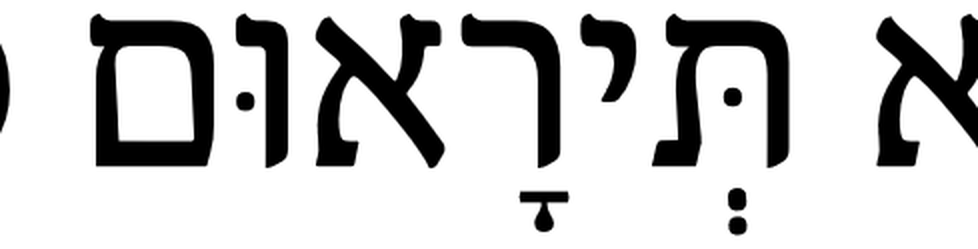
page 457 | IB partners the consensus ḥiriq with a sheva that is nonsensical, non-robustly encoded, and typographically mishandled.DetailsThe Israel Bible fails to use a CGJ (as at Exod 20:4, below), and thus leaves itself open to variable presentation depending on whether the environment does Unicode normalization or not. Normalization puts the sheva first, which in some fonts gives a false "ḥataf ḥiriq" look.[5]
As it turns out, the order of the two marks is immaterial due to IB's font's mishandling of this (admittedly outlandish) combination of marks. In IB's PDF (I have not inspected the paper edition), the font draws the ḥiriq and the sheva superimposed: the ḥiriq's dot lands almost on the sheva's upper dot, so the page shows something like a sheva with a misshapen top dot.
 |
|
| Isa 49:23
page 1054 | IB has a nonsensical ḥolam male dot on vav rather than a ḥolam ḥaser dot on qof. |
|
| Lam 3:25
page 1813 |
|
| Hos 2:17
page 1347 | IB has a nonsensical ḥiriq below a shuruq. |
|
| Jonah 3:2
page 1394 |
|
Missing vowels and dots
| Forms | Where | Notes |
|---|
| Gen 34:11
page 102 | IB has a final he without qamats. |
|
| Isa 23:8
page 1003 |
|
| Hos 2:4
page 1346 |
|
| Prov 31:12
page 1700 |
|
| 2 Kgs 18:27
page 940 | IB has no tsere on the first mem of this qere. |
|
| Isa 46:4
page 1048 | IB lacks the sin dot that appears in the consensus. |
|
| Zech 2:2
page 1436 | IB has the Jerusalem-related word without its orphan ḥiriq. |
|
| Prov 20:1
page 1679 | IB has no ḥiriq under the second yod. |
|
| Lam 4:4
page 1816 | IB has no vowel under the ḥet. |
|
| Eccl 2:23
page 1827 | IB has a bare vav instead of a ḥolam male. |
|
A sheva instead of a full vowel, or the reverse
| Forms | Where | Notes |
|---|
| Exod 1:3
page 151 | IB has a sheva instead of a ḥiriq under the bet. |
|
| Num 2:14
page 343 | IB has a sheva instead of a shuruq dot. |
|
| Dan 7:20
page 1891 |
|
| Judg 15:14
page 647 | IB has a ḥiriq under the shin instead of a sheva. |
|
| Judg 16:2
page 647 | IB has a sheva instead of a pataḥ under the resh. |
|
| 1 Sam 27:10
page 737 | IB has, on yod–resh, pataḥ–sheva instead of the reverse. |
|
| Joel 2:12
page 1367 | IB has a sheva instead of a ḥiriq under the first bet. |
|
| Ps 45:3
page 1516 | IB has a sheva instead of a ḥiriq under the sin. |
|
| Prov 12:9
page 1665 | IB has, on the mem–tav, sheva–pataḥ instead of ḥiriq–sheva. (Unlike IB's vowels, the ḥiriq–sheva vowels of the consensus make sense, being the vowels of the hitpael participle's prefix.) |
|
| Neh 9:14
page 1956 | IB has a pataḥ instead of a sheva under the ayin. IB has no dagesh in the tav. |
|
Qubuts-alef-shuruq
| Forms | Where | Notes |
|---|
| Num 26:7
page 412 | IB not only includes the LC's quirky qubuts, it does so without the rafeh on alef that makes this quirk less confusing (though still confusing). Its transliteration of this word as la-ru-vay-NEE (in Josh 12:6) is hard to justify against its Hebrew pointing. IB's 2 Kgs 10:33 form of this word lacks a dot in the vav; whether the word is more or less confusing this way is unclear. It certainly adds to the general confusion surrounding this word, which also appears in near-consensus form in IB 12 times. (By "near-consensus form" I mean with no qubuts, albeit with no rafeh either.) See also מאום at Job 31:7, below. See MAM's relevant FOI. |
|
| Deut 3:12
page 455 |
|
| Deut 3:16
page 456 |
|
| Deut 4:43
page 462 |
|
| Josh 12:6
page 571 |
|
| 2 Kgs 10:33
page 918 |
|
| Job 31:7
page 1752 | IB not only includes the LC's quirky qubuts, it does so without the rafeh on alef that makes this quirk less confusing (though still confusing). See also ראובני at Num 26:7, above. |
|
Miscellaneous
| Forms | Where | Notes |
|---|
| Gen 32:18
page 98 | IB has a ḥiriq instead of a shuruq dot. |
|
| 2 Sam 13:33
page 776 | IB has a ḥiriq in a word that is כתיב ולא קרי, so a reader would be encouraged to read it aloud. Elsewhere the Israel Bible leaves such a כתיב ולא קרי word unpointed (six places), with nothing else to mark it; it brackets only the qere words that it adds. At 2 Sam 15:21 the Israel Bible also has a maqaf after it. These two words are the subject of my "Saying the quiet part out loud". |
|
| 2 Sam 15:21
page 781 |
|
| Jer 3:17
page 1094 | IB has a dot in the first of the two final vav letters.[6] |
|
| Song 5:11
page 1785 | IB has a shuruq dot in the first vav instead of a qubuts under it. That vav is then a shuruq, a vowel directly after the qof's sheva, which makes no sense. |
|
| Dan 2:45
page 1875 | IB has a segol under the dalet instead of a tsere. IB's transliteration, v’-ha-DE-ket, spells the syllable with e, its spelling of segol. So its transliteration follows its Hebrew here, not the consensus. |
|
| Dan 5:24
page 1886 | IB has pataḥ under yod. |
|
| 1 Chr 3:1
page 1982 | IB has ḥiriq on yod rather than vav. |
|
The Decalogues
The Decalogues are among the most challenging passages of the Bible to present. So, it is no surprise that the Israel Bible did not rise to the challenge. Each Decalogue has two cantillations, the טעם תחתון and the טעם עליון, which differ in a few of their non-accent marks as well as in their accents. (It is a little-known fact that the accent system interacts with the non-accent marks, i.e. the accent system is not, as an edition like IB pretends, fully separable from the system of vowel marks and dagesh.) In each of the 8 rows below, the Israel Bible's form is shown above MAM's עליון form. (We choose the עליון because it is the closer of the two cantillations to IB's text.)
| Forms | Where | Notes |
|---|
| Exod 20:3
page 198 | IB has the תחתון's qamats under the nun, and the עליון's pataḥ under the yod rather than the nun. |
|
| Deut 5:7
page 463 |
|
| Exod 20:4
page 198 | IB has both the תחתון's qamats and the עליון's pataḥ under the tav. At Deut 5:8, below, it has the qamats alone.DetailsIB does not use a CGJ between the two vowels (as at Deut 3:22, above), so its encoding is not robust to normalization, though that doesn't matter since for display purposes, IB got kind of lucky and its PDF (I have not checked the printed page) draws them at the same point: in its Hebrew typeface a qamats is a pataḥ with a stem added, so the pataḥ lands exactly on the qamats's bar and vanishes. Anyone who copies or searches the PDF's text, or the website's, still gets the pataḥ. |
|
| Exod 20:9
page 198 | IB has the תחתון's dagesh in the kaf. Correctly reflecting an error in the LC, WLC 4.18 has no rafeh here. Contrast with Deut 5:13, below. |
|
| Exod 20:10
page 198 | IB has the תחתון's maqaf. |
|
| Deut 5:8
page 463 |
|
| Deut 5:8
page 463 | IB has the תחתון's qamats under the tav instead of the עליון's pataḥ. At Exod 20:4, above, it has both. See also my note on the LC at Deut 5:8. |
|
| Deut 5:13
page 463 | IB has the תחתון's dagesh in the kaf. Correctly reflecting the LC, WLC 4.18 has an important rafeh here, but Sefaria stripped it.[7] |
|
In a long line
The Israel Bible is the latest in a long line of Hebrew Bibles slapped together from a Unicode conversion of WLC. One expects that of free websites. One expects better of printed books, which cost real money to make and to buy, but the line includes those too:
- Zondervan's A Reader's Hebrew Bible (2008) names its source, WLC version 4.4, and marks the places where WLC differs from BHS. Various follow-ons to this publication exist, including a second edition of this Reader (2026), as well as A Reader's Hebrew and Greek Bible, whose third edition came out in April 2026. But I assume that these follow-ons continue to use WLC, probably not even a more recent version of WLC.
- Hendrickson's A Hebrew Reader for the Pentateuch (2024) says in its preface that its Hebrew is WLC. This is the book I reviewed in "WLC Considered Harmful". The same publisher's A Hebrew Reader for the Psalms (2021), mostly a fresh transcription from the Aleppo Codex, shows what it could have done instead.
- Crossway's The Hebrew Old Testament, Reader's Edition (2021) cites its use of WLC: in its publisher's words, it "combines the text of the Westminster Leningrad Codex (WLC)" with glosses. With no qualifier such as "based on", that implies WLC's text verbatim.
- Timothy A. Lee's Hebrew Bible Readers say on their copyright page that their base text is based on WLC, and I can attest that "based on" means quite closely based on, i.e. with little or no editing.
- GlossaHouse's illustrated series does not say where its Hebrew comes from, but a review of its Genesis volume says that it is WLC with vowels and without accents, which is just what the Israel Bible gives its readers.
Use of ḥataf vowels under non-gutturals
One expects to find an occasional "ḥataf-NG": a ḥataf vowel under a non-guttural, i.e. under a letter other than the אהח״ע letters (alef, he, ḥet, and ayin). The Masoretes held a ḥataf necessary to mark a vocal shewa under a guttural but optional under other letters, and the manuscripts differ widely in how often they have one there (Yeivin, ITM §391). Cases of ḥataf-NG appear more frequently in IB than in a consensus edition such as MAM. These "excess" appearances, beyond the consensus, are not wrong, but they may surprise an intermediate student of Biblical Hebrew.
The counts below include resh but leave out the divine-name-related cases that might be included if their implied qere is ignored.[8] IB has 431 cases of ḥataf-NG, 225 of which are in agreement with MAM.[9] None of the cases in agreement with MAM is a ḥataf pataḥ: under a non-guttural, MAM has only a ḥataf qamats or a ḥataf segol. That leaves 206 cases of excess ḥataf-NG in IB, 97 of them under resh alone. (MAM has only one ḥataf under resh, in רֳאִי at Gen 16:13, and IB has this one too.)
Unlike IB, MAM has a special notation for a ḥataf under a non-guttural in authoritative manuscripts. That notation is the varika mark, which MAM has 674 times, as on the lamed of MAM's וּלְﬞהַבְדִּיל at Gen 1:18, where IB has a ḥataf pataḥ. So, though MAM has only a simple sheva rather than a ḥataf vowel on these letters, the varika mark records the ḥataf vowel that might surprise the intermediate student. MAM marks 194 of IB's 206 cases of excess ḥataf-NG with the varika, which makes something close to agreement between the editions for those cases.
Conclusion
Through a series of examples, we have demonstrated the perils of just slapping together a Hebrew Bible using WLC. The result is nothing like a Koren Bible, which is a consensus edition biased towards the printed tradition and providing pronunciation aids that have become common. Nor is the result like MAM, a consensus edition biased towards the manuscript tradition but not slavishly diplomatic to any one exemplar of that tradition.[10]
Related work
I have written about WLC before, in my series "Undoing and redoing the work of the Masoretes" and in "WLC Considered Harmful", my review of A Hebrew Reader for the Pentateuch. That review lists the quirks the Reader inherited from WLC, and every one of them that survives the stripping of the accents is in the Israel Bible too.
Other works by me about the Masoretic Text can be found in this index of my documents.